Pikeville CITY PARK

Highlights
In January of 1862, following his great victory at the Battle of Middle Creek, Union colonel James A. Garfield led his brigade to Pikeville and used Ratliff's tavern, once located at present-day city park, as his base of operations. Garfield received his promotion to brigadier general while stationed at the tavern. His troops camped on this site until a flood forced them to the hill where the University of Pikeville is presently located. Ratliff's tavern was demolished in the 1930s but the site is commemorated by historical markers detailing the area's Civil War history. Additionally, the park boasts a large statue of Mayor Hambley (1960-1989), the mayor who moved a mountain, and a memorial to Shady Grady Kinney, founder of Hillbilly Days. The Pikeville City Park Restoration Project was completed in June of 2008.
PIKEVILLE UNITED METHODIST CHURCH
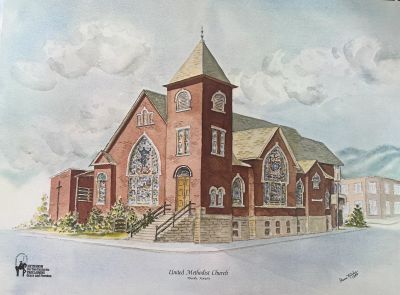
History
The Pikeville Methodist Episcopal Church, South was organized on Main Street in 1845, soon after the Methodist Episcopal Church's General Conference of 1844. In 1885, the church and representatives of Masonic Lodge No. 375 acquired a brick building at 339/341 Main Street; they occupied this structure until 1911 when the building was sold and used to purchase the current location. The present-day Methodist Episcopal Church, South structure, located at 107 Main Street near Pikeville City Park, was dedicated on June 22, 1913. In 1939, the Methodist Episcopal Church, South joined with two other denominations to form The Methodist Church. In 1968, it united with another denomination to form The United Methodist Church, which explains the church's present-day name.
pikeville POST OFFICE AND FEDERAL BUILDING
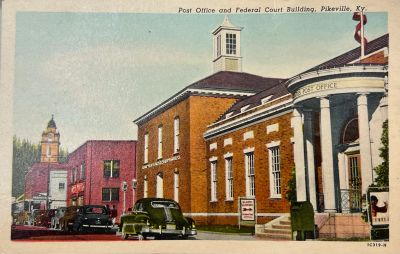
History
The Pikeville Post Office building was erected in 1931 using designs from supervising architect James A. Wetmore. In 1940, the federal courthouse building was added, reflecting colonial revival/Georgian-style government architecture. Both structures are contributing properties within Pikeville's historic district listed on the National Register. The Main Street post office branch continues to serve the community, having undergone local repairs and reopening updates in late 2020 following water damage.
Hotel James hatcher
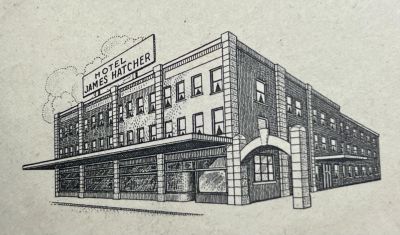
History
The Hotel James Hatcher, built in 1931 on Main Street, contained 106 rooms. In its spacious lobby was a small museum displaying ox-yokes, handmade furniture, weapons, a huge fireplace, and utensils used by early settlers. The walls were covered with historical data, favorite mottos, and philosophical sayings. In one room, Hatcher kept on display his own coffin, which had been fashioned out of a walnut tree that once stood on the hotel's lawn. On July 3, 1934, First Lady Eleanor Roosevelt briefly visited the hotel. It was demolished prior to 2005.
pike county courthouse
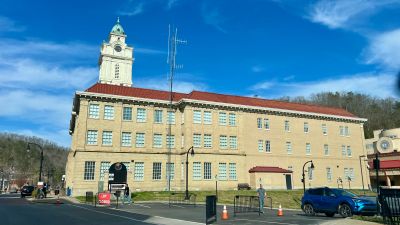
History
The Pike County Courthouse seen today was originally constructed as a red-brick building in 1888-89 on Main Street to replace a frame structure erected in the mid-1820s. In the early 1930s, the courthouse was remodeled and enlarged; the new courthouse encompasses the older red-brick building. Since the late 1880s, the 2nd floor courtroom has hosted numerous trials important to local history--the most significant undoubtedly related to the Hatfield-McCoy Feud. To read the U.S. Supreme Court's decision in Mahon v. Justice (1888), go here: https://supreme.justia.com/cases/federal/us/127/700/ A historical marker for the courthouse was erected in 1990.
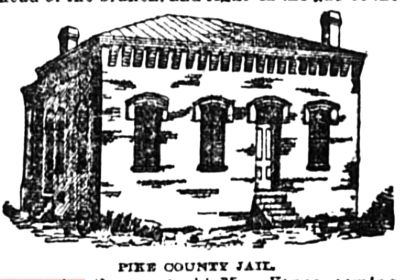
pike county jail
History
This image shows the Pike County Jail as it appeared during the Hatfield trials in 1888-90. At least one jail built after this one was demolished during the 1980s to make way for the current detention center. So far as is known, the county jail has always been located behind the courthouse.
steamboat landing
History
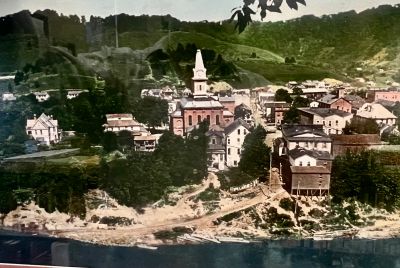
The old steamboat landing for Pikeville was located approximately where Division Street extends to Riverfill Parking Lot in modern times. Because of the famous Pikeville Cut-Through Project, the river that once flowed behind the courthouse is now gone.
COL. JOHN DILS RESIDENCE

History
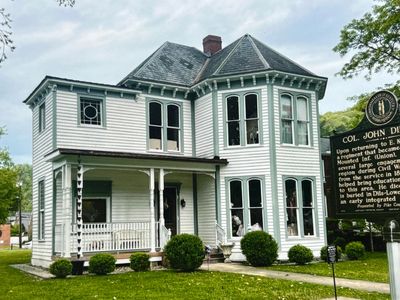
Col. John Dils, a merchant and one of the most prominent Unionists in the upper Big Sandy Valley during the Civil War, occupied his new home in 1867. After his death in 1895, the mansion came to be occupied by his son, John A. Dils. For unknown reasons, the home was torn down in 1945. In 2016, a historical marker for Col. Dils was placed in the yard of his daughter's home. Our museum features several notable items from Col. Dils' residence, such as his bedroom suite which he ordered after observing what later became known as the Lincoln Bedroom at the White House early in the Civil War.
james and augusta york RESIDENCE
History
We are developing this entry.
perry cline RESIDENCE
History
We are developing this entry.
sally mccoy RESIDENCE
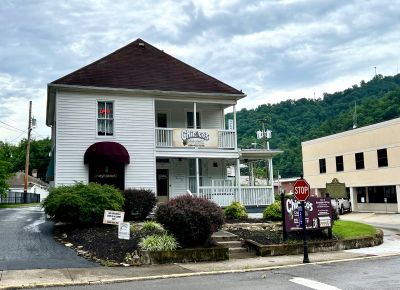
History
We are developing this entry.