Mayor W.C. Hambley (1960-1989)

History
Dr. William C. Hambley (who served as mayor from 1960 to 1989) guided Pikeville through a transformative decade of modernization, positioning Pikeville as a growing commercial and civic hub for Central Appalachia. Planning and early work for "Hambley's Dream"—the monumental Pikeville Cut-Through project—began in 1968 to reroute the river, railroad, and highway through Peach Orchard Mountain to relieve severe traffic congestion and land scarcity.
To hear an interview excerpt with Dr. Hambley, go here: https://www.youtube.com/shorts/YM4iuLOP8xs
kennedy years (1961-1963)
History
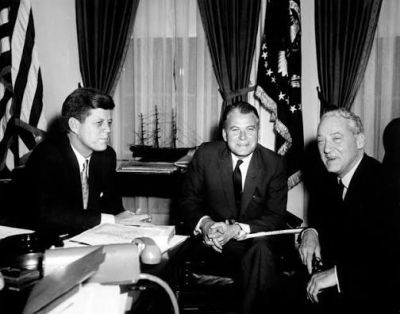
Following his 1960 primary campaign in neighboring West Virginia, President John F. Kennedy made chronic unemployment in the coalfields a central part of his domestic agenda. He established the President's Appalachian Regional Commission in 1963, which laid the groundwork for the War on Poverty and the Appalachian Regional Commission later signed into law by President Lyndon B. Johnson. On November 13, 1963, just nine days before he was killed in Dallas, Kennedy met at the White House with Kentucky Governor Bert Combs and the state's congressional delegation. They discussed an intensive federal aid program for economically distressed Eastern Kentucky, and Kennedy planned to visit the region with Combs in December 1963 to highlight poverty in Appalachia.
vietnam war
History
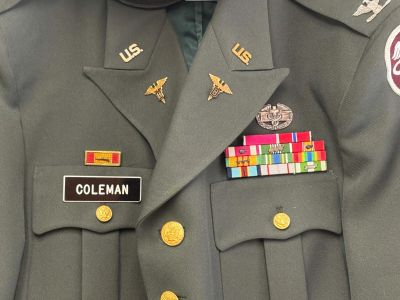
Pike County residents served from the early advisory stages of the conflict through the final withdrawal. Local historical accounts highlight Bob Mohr as the first Pike Countian documented to have served and returned from Vietnam in November 1963. Service members from across Pike County—including Pikeville, Virgie, Regina, Elkhorn City, Phelps, and Belfry—lost their lives during the war. Notable casualties documented in military records include Air Force Major Mannifred Yates of Pikeville, Army Sergeant Billy Wayne Bridgeman of Virgie, and Army Sergeant Jerry Roger Meadows of Regina. During the Vietnam era, Pike County was simultaneously at the center of major domestic events. The region was a focal point for President Lyndon B. Johnson's "War on Poverty" (including his 1964 visit to Eastern Kentucky) and saw intense labor disputes in the coal industry, creating a complex economic and social backdrop for young men entering the military or returning home.
For more about this topic in Eastern Kentucky, go here: https://www.youtube.com/watch?v=Hs4Hl2zMOQs
johnson years (1963-1969)
History
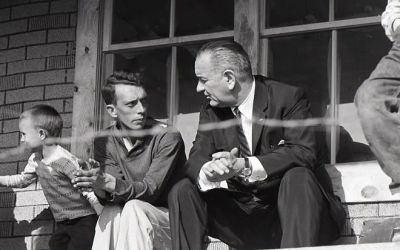
President Lyndon Johnson's 1964 visit to eastern Kentucky served as the emotional and symbolic centerpiece of his national War on Poverty. In April 1964, LBJ and his wife traveled to Paintsville in Johnson County and Inez in Martin County. In Inez, LBJ famously sat on the front porch of Tom Fletcher--an unemployed sawmill worker and father of eight--to talk about the harsh economic realities of the region. A well-known photograph and exchange from that day--where one of Fletcher's children asked the president if he could help stop his dad from crying at night--brought a human face to rural American poverty. The visit catalyzed major federal legislation and permanent institutions targeting Appalachia: the Economic Opportunity Act of 1964, the Appalachian Regional Development Act of 1965, Head Start, Medicare, and Medicaid. While the presidential visit unlocked federal resources and infrastructure investments, it also cemented a long-standing narrative that often stereotyped eastern Kentucky solely as a symbol of despair and destitution.
For a related documentary, go here: https://www.youtube.com/watch?v=qbUwR2K0s9A
Pikeville: All-America City (1965)
History
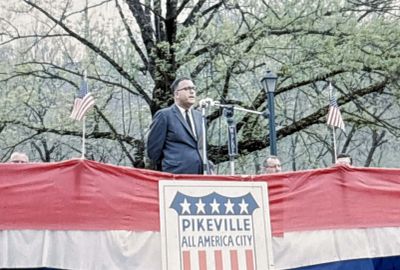
Pikeville was officially designated as an All-America City by the National Civic League in 1965. The All-America City Award recognizes communities that leverage inclusive civic engagement, collaboration, and problem-solving among residents, government, and local organizations to tackle critical local challenges. Following its recognition, Pikeville gained widespread attention for major civic and engineering achievements--most notably the massive Pikeville Cut-Through project completed between 1973 and 1987, which reshaped the local landscape for flood control, urban expansion, and transportation.
Kentucky Un-American Activities Commission Hearings (1967)
History
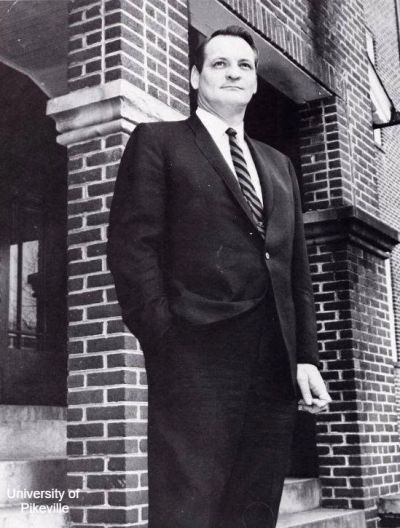
In the late 1960s, the Kentucky Un-American Activities Committee held hearings in Pikeville to investigate anti-poverty organizations operating in the region--specifically targeting the Appalachian Volunteers (AV) and their connections to progressive initiatives at Pikeville College. Thomas Johns, a liberal Presbyterian minister who became president of Pikeville College in 1967, supported progressive anti-poverty and community outreach efforts. His reforms drew sharp criticism from conservative locals, coal operators, and politicians who accused the college of harboring radical or subversive elements. While college campuses across the U.S. in the late 1960s saw left-wing anti-war civil rights student protests, Pikeville College experienced a rare reverse phenomenon: a conservative student revolt. A majority of the student body protested against President Johns and his progressive policies, aligning with local skeptics of the anti-poverty programs. Following the intense political presssure and KUAC hearing, Thomas Johns was forced out of Pikeville College in 1969 after just two years in office. Other anti-poverty figures in Pike County, such as Alan and Margaret McSurely, faced severe retaliation. Shortly after being accused of sedition during the KUAC hearings, were arrested, their Pike County home was bombed, and they subsequently left Kentucky. The McSurely incident triggered a 15-year legal battle over free speech and congressional overreach.
For more about the McSurely case, go here: https://www.facingsouth.org/1983/09/american-inquisition-part-i-trial-alan-margaret-mcsurely and here: https://www.facingsouth.org/1983/09/american-inquisition-part-ii-mcsurely-case-and-repression-1960s
RFK Visits Eastern Kentucky (1968)
History
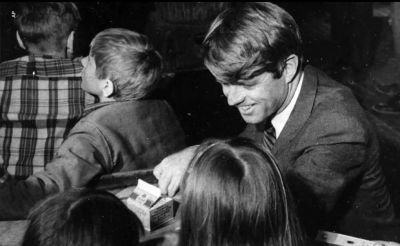
Senator Robert F. Kennedy fulfilled his late brother's focus to visit Eastern Kentucky with a famous two-day tour of the mountains in February 1968. Traveling as a U.S. Senator on a Senate subcommittee examining the effects of early War on Poverty programs, Kennedy drove more than 200 miles over rough mountain roads to speak directly with unemployed coal miners and local families. His itinerary included hearings at one-room schoolhouses in Vortex and Barwick, a walk through the Liberty Street neighborhood and a strip-mining site in Hazard, a stop at Alice Lloyd College near Hindman, and a hearing in Neon. Deeply affected by the severe hunger and lack of economic opportunity he witnessed in the region, he announced his campaign for the presidency less than a month later.
For more history, go here: https://www.youtube.com/watch?v=ZbebKDNorXE
Fishtrap lake and dam (1968)
History
Fishtrap Dam and Fishtrap Lake were built in Pike County, KY, by the U.S. Army Corps of Engineers between 1962 and 1968 to control devastating flooding along the Levisa Fork of the Big Sandy River. In January 1957, nearly 10 inches of rain had fallen along the Kentucky-Virginia border, triggering a record-breaking flood. Pikeville and surrounding Levisa Fork communities had suffered catastrophic property loss and millions of dollars in damage. Following the 1957 disaster, federal studies recommended a network of flood-control reservoirs across the basin, making Fishtrap Dam the centerpiece of the plan.
Work on the project began in February 1962 and took six years to complete at a cost of roughly $56 million. Crews excavated five million cubic yards of earth and rock to build a dam measuring 195 feet high and 1,000 feet long out of native rock with a waterproof clay core. Builders also used a distinctive "stairstep" excavation method on the left abutment, exposing 330-million-year-old Pennsylvanian Period rock strata. Impounding the 16.5-mile reservoir required buying out and relocating entire valley communities, including homes, schools, churches, and family burial grounds. The Corps of Engineers moved hundreds of graves out of the flood zone—most notably to the Annie E. Young Cemetery near Shelbiana—to preserve local family histories. The project created a 1,130-acre reservoir that has prevented hundreds of millions of dollars in downstream flood damage.
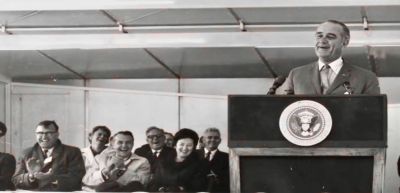
President Lyndon B. Johnson officially dedicated the dam on October 26, 1968. Arriving via helicopter to a large crowd of 5,000 people, Johnson highlighted regional protection, community development, and the newly launched Model Cities program.
For more history about Fishtrap Dam, go here: https://www.youtube.com/watch?v=K8Npl43X1KY&list=PLEGzyrQTmZZQrSRio4e1xP0lFFZv6clPm&index=27